
Novel Method Reduces Dissolved Oxygen Simulation Error in Dam Reservoir by 43%
Researchers at the University of Tehran have significantly improved the accuracy of water quality simulation in a deep, stratified reservoir.
According to the Public Relations Office of the University of Tehran, researchers in the field of water resources engineering and management at the University of Tehran, by developing a novel approach based on Data Assimilation and dynamic updating of model parameters, have succeeded in significantly increasing the accuracy of water quality simulation in a deep, stratified reservoir.
Dr. Reza Kerachian, Professor at the Faculty of Civil Engineering, College of Engineering, University of Tehran, explaining this research, said: "Complex water quality simulation models, especially in deep and stratified reservoirs, face challenges such as parameter uncertainty, calibration difficulties, and the variability of physical and chemical processes over time. The use of fixed parameters under such conditions can reduce the model's ability to accurately represent the actual behavior of the reservoir."
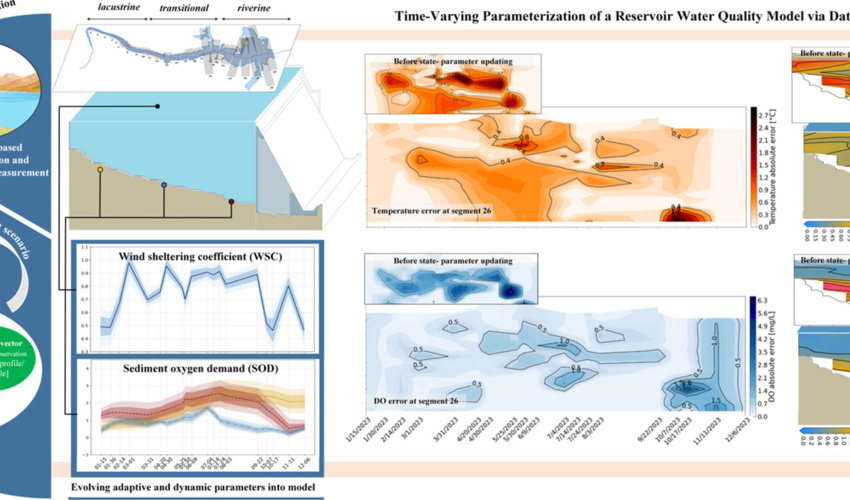
He added: "In this research, utilizing the data assimilation approach and the Ensemble Kalman Filter, an automatic, adaptive, and uncertainty-based framework was presented for dynamic calibration of water quality simulation model parameters. This method, using observational data based on remote sensing, allows for the updating of model parameters over time and enables the model to adapt itself to changes in environmental conditions and the processes governing the reservoir."
Dr. Kerachian continued: "This approach was evaluated in the Wadi Zigha Dam reservoir in Oman, and its performance was examined in simulating two key variables, namely temperature and dissolved oxygen. The results showed that time-varying parameterization, compared with the use of fixed parameters, significantly improves model performance; such that the root mean square error of dissolved oxygen profile simulation decreased by 43 percent, and simultaneously the temperature profile decreased by 16.8 percent."
This research was conducted by Dr. Reza Kerachian, Dr. Mohammad Reza Nikoo, Dr. Sadegh Vanda, and Farnaz Sadat Shahi from among researchers in the field of water resources engineering, and so far part of its results has been published in the reputable international journal Water Research with an impact factor of 12.8.
According to these researchers, dynamic updating of model parameters, in addition to increasing its ability to adapt to changes in reservoir conditions, can also partially compensate for the effect of missing, simplified, or inadequately represented processes in the model structure. Therefore, the use of dynamic and adaptive parameters can help increase the reliability of water quality simulations and support smarter management and operation of dam reservoirs under changing environmental and climatic conditions.
The title of this article, published in Water Research, is:
Time-Varying Parameterization of a Reservoir Water Quality Model Using Data Assimilation
Your Comment :